Activated carbon is an effective and flexible filter medium used in many industries, removing impurities to give cleaner, safer and more environmentally friendly results. Read on to find out how activated carbon for water treatment works in filtration systems, its advantages and the key points to consider when using it at your facility.
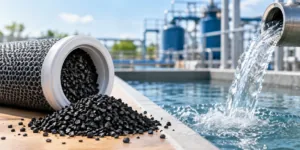
Activated carbon is made from materials with a high carbon content, such as coal, coconut shell and wood. An activation process makes it more porous and greatly increases its surface area, which makes it very effective at retaining a wide range of impurities and contaminants.
Carbon filtration is widely used in many sectors, including manufacturing, breweries, water treatment and wastewater management. It is also used in vapour-phase activated carbon systems to control air pollution from vapours and gases released to the atmosphere. Industrial-grade activated carbon filters effectively remove contaminants such as:
- organic materials
- pesticide residues
- per- and polyfluoroalkyl substances (PFAS)
- hydrocarbons
- phenolic compounds
- chlorine and its by-products
- unpleasant tastes and odours.
The key to its effectiveness is its large surface area and porous structure, which maximise its capacity to capture contaminants. With activated carbon for water treatment, industries can effectively remove impurities and maintain high water quality standards.
What are the advantages of activated carbon in industrial filtration?
As well as the many chemicals it can remove, activated carbon has several advantages over other filter media:
High adsorption capacity
Its large surface area and porous structure allow activated carbon to adsorb substantial quantities of impurities. This high capacity ensures effective contaminant removal, giving a cleaner final product and reducing how often the filter needs replacing.
Environmentally friendly
Activated carbon is an environmentally friendly filtration option, as it can be made from renewable, natural raw materials. Spent activated carbon can be reactivated and reused, reducing its environmental impact.
Cost-effective
Activated carbon is an efficient and economical solution for industrial filtration. Its ability to deal with a variety of contaminants and its reusability allow facilities to save on materials and operating costs.
Key factors when using activated carbon in industrial filtration
To get good performance from activated carbon in industrial filtration systems, several factors need to be considered:
Particle size
The particle size of the activated carbon affects both its adsorption kinetics and the pressure drop in the system. Smaller particles generally adsorb faster but cause a higher pressure drop, so the two need to be balanced for good filtration results.
Type of activated carbon
Different types of activated carbon are available, including bituminous coal-based carbon, coconut shell granular activated carbon (GAC) and powdered and extruded grades. The choice depends on the specific application and the filtration performance required.
Pretreatment
In some cases the activated carbon needs to be pretreated to increase its adsorption capacity or protect it from fouling. This may involve impregnating the carbon with specific chemicals or installing a pre-filter to remove larger particles.
Regular maintenance
Regular checks and maintenance of the filtration system are essential to maintain performance and avoid breakthrough. This includes monitoring pressure drop and the carbon bed, and replacing or reactivating the spent carbon as needed.
The bottom line
Activated carbon is a powerful, versatile and cost-effective solution for industry. If you are not sure whether activated carbon suits your business, or want to make sure you get the right filtration system, see our activated carbon or contact KEIKEN.