
- Home
- Compact Plants
- Desalination

Compact DESALINATION plants.
We design and manufacture compact desalination plants from 20 to 2,500 m³/day to convert seawater or brackish water into water suitable for human consumption using reverse osmosis with energy recovery. Plants are delivered factory-tested and arrive at their destination ready to connect.
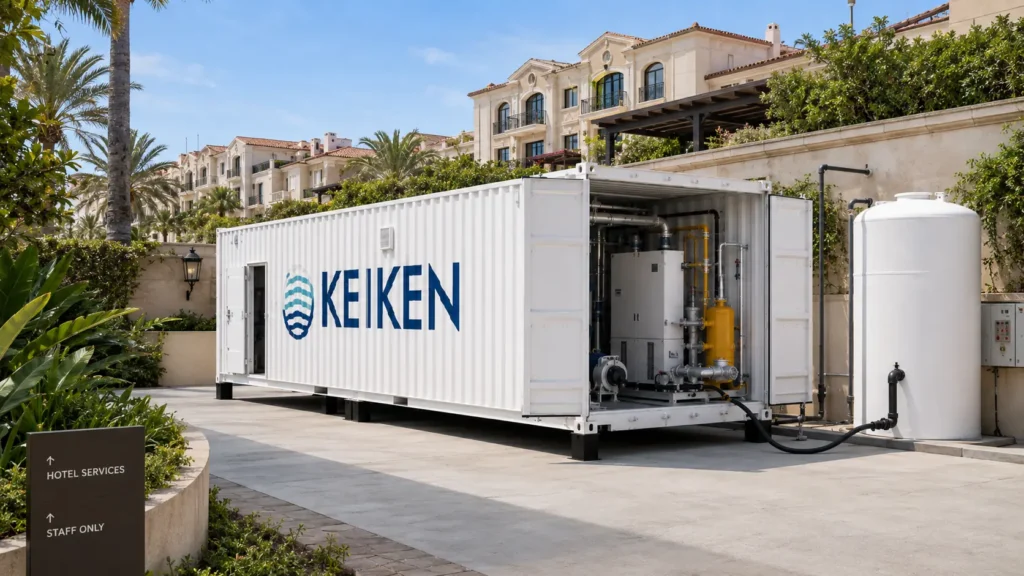
Skid-mounted or containerised (20 or 40 feet)
Arrive and connect
45% recovery rate
Reduced O&M and remote monitoring
Low energy consumption
Seawater desalination
KEIKEN offers compact, mobile and containerised seawater desalination plants, designed to produce high-quality fresh water efficiently and reliably, even in remote locations and challenging conditions.
Their Plug & Play design enables rapid commissioning: plants are manufactured and tested at the factory, arriving at their destination ready to connect and operate. The 20- and 40-foot container format offers considerable versatility for domestic and international transport and final installation.
The All-in-One solution combines multimedia filter pretreatment, reverse osmosis, a CIP system and post-treatment with chemical dosing in a single system, according to the final use, whether for human consumption or applications such as irrigation or washdown. Its operation is fully automatic, with control systems, remote monitoring, configurable alarms and notifications, reducing operation and maintenance requirements.
With an adaptable capacity from 20 to 2,500 m³/day, low energy consumption and the option to customise outlet water quality, KEIKEN plants offer a fast, flexible and cost-effective solution tailored to the specific needs of each project.
Sectors
Hotels Campsites Resorts Marinas Golf courses Municipalities Other
Brackish water
Lower salinity and operating pressure, with greater recovery potential and lower energy consumption.
From design to commissioning.
Design and engineering
We size each plant to meet the required flow rate and water quality.
In-house manufacturing
We integrate equipment, piping, instrumentation and automation at our facilities.
FAT testing
We test and validate the plant in our testing area before dispatch to reduce adjustments at its destination.
Commissioning
We install, start up and verify the plant’s operation at its destination.
Support and control
Technical support, monitoring of parameters, alarms and operation, with optional remote monitoring.
What are the benefits of a compact desalination plant?
Water independence. A reliable supply to meet demand.
-
Continuous supply. No supply restrictions or potential mains outages.
-
Efficient production. Systems that optimise energy consumption and maximise plant performance.
-
Water of exceptional quality and taste. Optimal water quality for human consumption.
-
Less transport, fewer emissions. Producing water directly where it is used reduces the associated carbon footprint.
-
Desalination where and when it is needed. Self-contained, containerised Plug & Play equipment. A versatile solution.
Experience demonstrated on site.
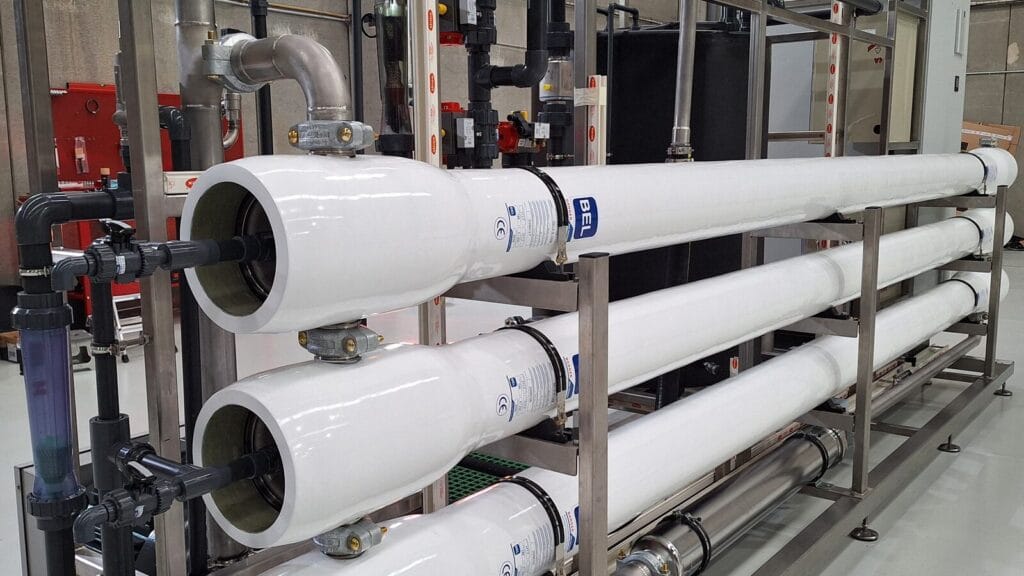
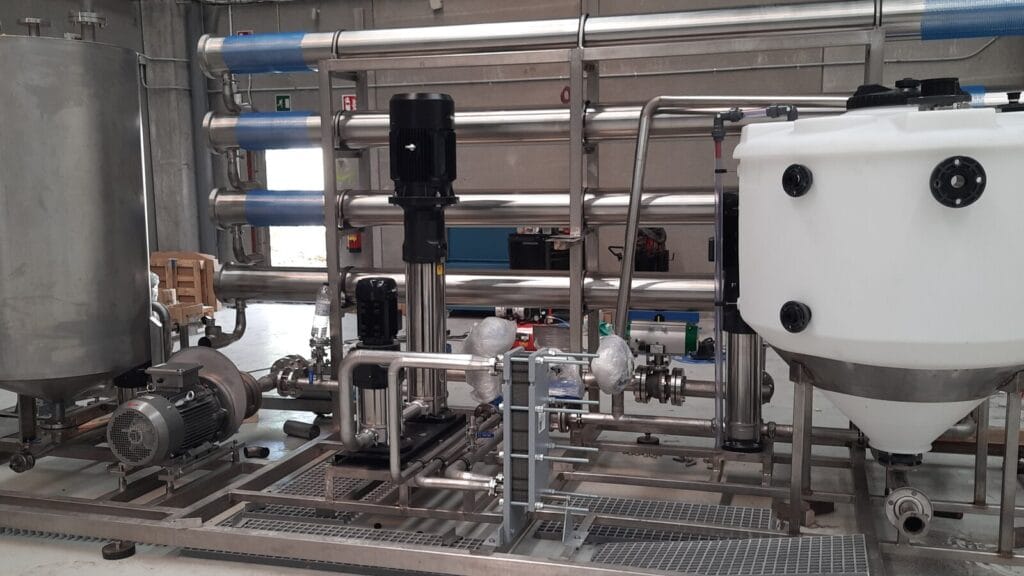
A selection of projects where we have provided engineering, equipment or installation in different settings.
Your questions about compact desalination, answered.
What is the difference between desalinating seawater and brackish water?
Feed water salinity affects pressure, energy consumption and recovery. Seawater usually requires higher pressure; brackish water may allow different operating conditions. We size the plant according to the actual water composition, temperature and required product water quality.
What flow rate can a compact desalination plant produce?
KEIKEN plants are sized to produce between 20 and 2,500 m³/day of product water, depending on the source and required quality. Capacity and potential expansion through modules are defined during engineering.
How does a reverse osmosis desalination plant work?
Pretreatment conditions the water before it reaches the membranes. A pump forces it through them under pressure, producing two streams: product water and concentrate or brine. Post-treatment adapts the product water to its intended use.
How much energy does a compact desalination plant consume?
There is no single consumption figure. Water salinity and temperature, flow rate, recovery rate and equipment efficiency all influence consumption. Energy recovery is assessed for seawater. The technical proposal should state the expected specific energy consumption and the assumptions used to calculate it.
How much space does a containerised or skid-mounted desalination plant need?
The footprint depends on the flow rate, pretreatment and chosen format. In addition to the equipment, provision is needed for maintenance access, connections, chemical storage and concentrate management. We review the available space before finalising the layout.
What pretreatment does a reverse osmosis plant need?
It is defined through water analysis and may include filtration, chemical dosing and cartridge filters. The choice of filtration media and other stages aims to limit membrane fouling and maintain stable operation.
Can desalinated water be used for human consumption?
Potable use requires appropriate post-treatment, disinfection and quality controls; salt removal alone does not complete this process. See also our drinking water treatment plants to assess the complete water supply treatment train.
Can the plant operate automatically and be controlled remotely?
The plant can incorporate a PLC and HMI to monitor parameters, alarms and operating sequences. Remote monitoring and support are included when they form part of the project scope.
What maintenance does a compact desalination plant require?
It includes monitoring pressures, flow rates and conductivity; checking pumps and dosing; replacing consumables; and cleaning or replacing membranes according to their condition. The operating manual defines the tasks and frequencies for the supplied configuration.
What do you need to prepare a proposal and what can it include?
We need a water analysis, product water flow rate, target quality, location, space and available utilities. Supply may include engineering, manufacturing, FAT testing, installation, commissioning and training. Send us your project details to define the scope.
Tell us the flow rate and final water quality you need.
Every project starts with different conditions. Tell us the flow rate you need to produce and the target quality. Our team will study the data and help you define the most suitable configuration, capacity and treatment level for your project.
You do not need to have the plant defined. Sizing begins with understanding your needs.
From a temporary water supply requirement to a permanent installation, we size each plant according to the required flow rate and target quality. Send us the basic project details and our engineering team will assess the most suitable solution.
We are a B Corp company
B Corp certification independently assesses a company’s environmental and social performance, transparency and legal accountability. For us, it is more than another seal of approval: it is the framework that guides our technical decisions. Every plant we design is also assessed for its energy consumption, the water footprint it helps reduce and its impact where it is installed.