Keiken, innovation in desalination

Microplásticos en el agua potable

The current situation of desalination by membranes is mainly based on processes of reverse Òsmosis (RO) and thermal desalination without membrane in MSF and MED processes, however, both technologies carry high energy consumption. In KEIKEN we propose a series of points to improve and get some technologies that achieve:

• Reduction of energy consumption.
• Reduction of the use of chemical products.
• Reducing risk and operating pressures.
• Reduction of costs with alternative materials.
• Improve the sustainability of the desalination process.

From KEIKEN two disruptive technologies are proposed: membrane distillation (MD) and adsorption desalination (AD), respectively.
Membrane distillation is a process of thermal desalination of seawater and brackish water, in which water vapor molecules pass through the pores of a hydrophobic membrane, leaving behind the salt molecules and other particles. The driving current is generated by the difference in vapor pressures on both sides of the hydrophobic membrane caused by a temperature difference between both sides of the membrane.


On the other hand, the desalination by adsorption being also a process of thermal desalination of seawater and brackish, differs from the previous technology in this case there is no membrane, but is used a selective sorbate with water vapor. Thanks to the generated vacuum, it is possible to reduce the boiling temperature of seawater and reduce energy consumption compared with conventional thermal desalination processes, MSF and MED. This process consists of 3 stages: evaporation in vacuum, adsorption and condensation.
These disruptive technologies are proposed as alternative processes a Reverse Osmosis (RO), MSF and MED. With these proposed alternatives is achieved a considerable reduction in energy consumption (< 1 kwh/m3 water produced), work at lower operating pressure (< 2 bar), operate with very high salinities without pressure increases, a lesser need for pretreatment and Reduce the dosages of chemical products.

These alternative desalination technologies need to be developed and bet on them. In order to improve its efficiency and versatility, in KEIKEN we propose the hybridization with Renovavbles Energies, becoming very sustainable technologies by significantly reducing energy demand and Carbon Footprint.

To request our Water Treatment solutions, Energy Efficiency services or more information, you can contact us by email info@keiken.es.

Use of anthracite in water treatment and purification

Uso de la antracita en tratamiento y depuración del agua

Filter media are materials that allow the passage of raw water through them and retain the particulate matter. Filter media are selected based on desired physical characteristics, such as specific size, gravity and particle sizes.

In KEIKEN we supply quality filtering media, suitable for each application in wastewater treatment and water purification. In addition, we maintain exclusivity agreements with manufacturers around the world, which allow us to have an unbeatable quality of the product and with a very competitive price.

In this post we will focus on Anthracite as a filtering medium in the treatment and purification of water.

ANTHRACITE

It is a high-hardness mineral coal of great carbon content. It is formed, like all mineral coals, by a slow process (millions of years) of plant transformation by effect of pressure and temperature. It is the last one on the scale of the Cobonus, and the one that more temperature and pressure needs to form. It is black and shiny, the most dense and hard of the carbons, with a high carbon content (more than 95%).
Anthracite is an excellent filter media for water clarification in drinking or industrial use, when used in combination with filtering sands. It is one of the most used filtering media. It is a good complement for the mixed filters, in company of sand or green manganese sand. Due to the special shape of its grains, it allows the suspended particles to be retained in the depth of the filtering bed. Compared to a sand filter, this filtering medium allows a higher flow, less pressure drop and a better and faster backwash.

Anthracite filter materials are specifically selected from deep mines with the highest percentage of carbon.

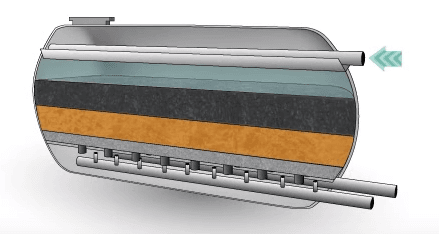
FILTRATION THROUGH MULTILAYER BEDS

Filtration through multilayer beds is a technique widely used in the elimination of suspended particles the raw water, having its main applications in the wastewater purification stations, desalination and drinking water treatment.

Filtro de agua con lechos multicapa

Filtration can be done through a single filter bed or several overlapping. In the multilayer beds, normally, the less dense filtering media such as anthracite are placed on the upper part, pretending that the solids are kept in this area of the bed. After the first layer of the finest material, such as sand, it follows another layer of coarser sand, a layer of fine gravel and finally a thick gravel layer as a support. Anthracite is characterized by producing reliable improvements in turbidity extraction, mainly thanks to its greater capacity to retain solids.

From KEIKEN we can offer our experience and versatility in offering a filter media and anthracite of exceptional quality at a very competitive price. Do not hesitate and request more information at info@keiken.es.

To request our Water Treatment solutions, Energy Efficiency services or more information, you can contact us by email info@keiken.es

FAQs

1. What are the best practices for changing activated carbon filters that are in use?

When using activated carbon filters, the user is advised to have them replaced regularly, depending on usage and water quality. Most filters need to be replaced every 2-6 months to remain effective at removing contaminants and maintaining water quality.

2. What is the relation between water flow rate and activated carbon filter performance?

The rate of water flow directly affects the rate of the filtration process. The carbon might not be able to absorb contaminants when users allow excessive water flow. A reduction in flow rate will increase contact time and enhance purification.

3. Are activated carbon filters effective when used in combination with other systems?

Yes, the activated carbon filters are commonly used in conjunction with other systems such as Reverse Osmosis (RO) or a UV purifier. This combination results in better water quality as other contaminants are removed.

4. What are the signs to know that the activated carbon filter is ineffective?

If you are a user, you can taste the water, smell it or see its turbidity. Regular monitoring and replacement would be carried out for the best results.

5. Is activated carbon being used by industries to treat specific contaminants as opposed to other methods?

Industries prefer to use activated carbon because it eliminates organic substances, chlorine and odours and does not strip out essential minerals.

Keiken and the carbon footprint

Keiken, cálculo de la huella de carbono

As mentioned above, an Energy Audit It is the basic tool to be able to identify the energy saving in the companies. It consists in the realization of a diagnosis that allows to know the situation of the company with regard to the energy consumption and CO2 emissions. This diagnosis identifies the energy saving and efficiency measures that could be implemented in order to minimize consumption and Reduce the carbon footprint.
On the other hand, la Energy Efficiency It is a practice that aims to reduce energy consumption. Energy efficiency is the efficient use of energy to optimize production processes using less energy and to produce more goods and services. In other words, produce more with less energy. It’s not about saving light, it’s about lighting up better by consuming less electricity, for example. Energy efficiency significantly reduces the carbon footprint.
The carbon footprint of an organization is the totality of greenhouse gases emitted by direct or indirect effect through the activity developed by the organization.

The most complete method of calculating the carbon footprint and proposing measures to improve the energy efficiency customized, is conducting an energy audit prior to the study and calculation of the carbon footprint. After performing the corresponding energy efficiency study, the following steps must be carried out:

1. Calculation of the carbon footprint from the documentation provided and the energy audit data.
2. Registration in the Carbon Footprint Registration Bulletin and submission of necessary documentation.
3. Elaboration of an emission reduction Plan. It consists of a series of improvement recommendations to reduce the carbon footprint.
4. Estimate Of the carbon footprint with the proposed improvements in the emission reduction Plan.

KEIKEN ENGINEERING as an Energy Efficiency provider, it has experienced professionals capable of conducting the required energy audits and calculating the carbon footprint. Our team of energetic auditors has experience, training and the best equipment to provide the best service.

To request our Water Treatment services, our Polyelectrolyte preparation equipment or more information, you can contact us by email info@keiken.es.