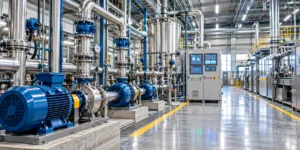
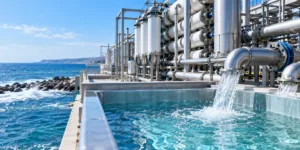
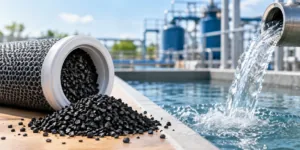
One of KEIKEN’s R&D projects is a ‘Sustainable desalination plant for an efficient water and energy management cycle’, which has been officially certified as an IBEROEKA project.
At KEIKEN Engineering we have taken a number of key factors into account to carry out this project successfully: the distillation configuration, the type of membrane and the pretreatment.
Membrane distillation (MD) configurations applicable to the project
In this project we have an unlimited supply of seawater at a maximum temperature of 17 °C, so the seawater should be used as the cooling water source. With these conditions, there are four possible configurations:
Direct contact. A membrane separates the two fluids at different temperatures. This arrangement is ideal when the cooling water is distilled water, but it is not viable if seawater is to be used as the coolant.
Air gap. Hot water is on one side of the membrane; on the other is the vapour that has passed through the membrane, together with air. This air–vapour stream is in contact with a wall cooled by the cooling water, in this case seawater, which condenses the vapour and collects the product water.
Sweeping gas. A hydrophobic membrane allows only volatile compounds to pass. On the other side of the membrane, a gas acts as the coolant.
Vacuum followed by a condenser. A vacuum is applied to improve permeate production, and a condenser is then needed for the vapour that has passed through the hydrophobic membrane.
We chose the air gap configuration because it uses seawater as an unlimited source of cooling water, there is no direct contact with the permeate, and it gives good results with low additional energy consumption thanks to hybridisation with renewable energy in the feed water heating stage.
Air gap configuration

Membrane considerations
- They must be hydrophobic, so that only volatile compounds pass through and non-volatile salts are retained.
- Membrane materials depend directly on the water characteristics, but the most common are PVDF, PTFE and PP.
- Porosity, membrane size and thickness determine the permeate flux. The most suitable configuration must be chosen to achieve the best efficiency.
- Another very important design factor is the module arrangement: tubular, flat-sheet or spiral-wound. The most suitable arrangement must be studied for each case and set of conditions. For example, flat-sheet modules are among the most efficient and allow a higher permeate flux, but they require a larger footprint.
Pretreatment
Depending on the quality of the water to be treated and the characteristics of the membranes, pretreatment may or may not be needed. Membranes are generally very sensitive to high concentrations of dissolved salts, algae and other compounds that may be present in the water. In these desalination processes, antiscalant dosing can be used to prevent scaling, and/or pH adjustment.

To find out more about KEIKEN’s membrane distillation projects with renewable energy, see our COMPACT PLANTS.
For our services or more information, email info@keiken.es or contact us.