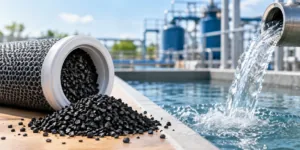
Every desalination plant has the same goal: to produce high-quality water while keeping operating costs under control. Therein lies the challenge. Even the best reverse osmosis system struggles if pretreatment is not efficient. That is precisely why more and more desalination facilities are replacing conventional media with pumice.
At Keiken Engineering, this volcanic stone is used as a naturally porous filtration material that delivers excellent filtration while improving overall desalination performance. If you operate a plant and are looking for high-performance pumice filtration media or lightweight media for RO pretreatment, our filtration solutions will help you improve water quality.
Contents
- How does pumice protect reverse osmosis membranes?
- Why is pumice better than anthracite filters?
- Does pumice reduce backwash water and energy costs?
- How does pumice improve desalination plant efficiency?
How does pumice protect reverse osmosis membranes?
Reverse osmosis membranes are the heart of every desalination system. Keeping them clean means fewer shutdowns, lower maintenance costs and more consistent water production.
Our experience in water treatment has shown that effective pretreatment starts with the right filtration media. Pumice acts as the first line of defence before the water reaches the RO membranes.
The main ways pumice protects your RO system:
- Removing suspended solids before they reach the membrane
- Reducing membrane fouling caused by fine particles
- Minimising head loss during filtration
- Extending membrane life by reducing wear
- Reducing cleaning frequency and overall maintenance costs
- Helping to keep the quality of water entering the RO unit stable
In short, cleaner feed water means healthier membranes and a more reliable desalination process.
Also read: Applications of pumice for removing impurities and toxins from drinking water
Why is pumice better than anthracite filters?
Anthracite has been used in water filtration for decades. Today’s desalination plants, however, demand much higher efficiency and lower operating costs, and this is where pumice stands out.
The naturally porous structure of pumice captures more contaminants while remaining lightweight and easier to maintain.
Key reasons why pumice performs better:
- Higher solids-holding capacity
- Lower head loss across the filter bed
- Better bed expansion during backwash
- Lower water consumption during cleaning
- Suitable for both fresh water and seawater applications
- Durable mineral structure with a long service life
These advantages make pumice one of the most effective RO pretreatment media for modern desalination facilities.
Does pumice reduce backwash water and energy costs?
Backwashing is needed to restore filter performance, but it can also be one of the largest operating costs of a filtration system.
The low density of pumice allows the filter bed to expand more easily during backwash. The result: less pumping energy, lower water consumption and shorter cleaning cycles.
Instead of devoting excessive resources to cleaning, a desalination plant can concentrate on producing treated water with fewer interruptions. Over time these operating savings become significant, particularly in large plants running continuously.
How does pumice improve desalination plant efficiency?
Every improvement in pretreatment has a positive knock-on effect throughout the desalination process.
We believe efficient filtration is about more than removing particles; it is also about helping the whole plant run more smoothly. Pumice maintains better flow through the filter bed, reduces clogging and downtime, and allows longer runs between backwashes.
Its highly porous surface provides an excellent structure for retaining particles while keeping filtration performance consistent. Combined with lower operating costs and better membrane protection, pumice helps desalination plants increase productivity without adding complexity.
This makes pumice a smart investment for facilities focused on savings, sustainability and long-term reliability.
Ready to transform your desalination process?
Cleaner water starts with better filtration. If you want to improve RO efficiency and reduce operating and maintenance costs, consider changing your filtration media.
Keiken Engineering offers water treatment solutions that help desalination plants get the most out of their installations. Contact Keiken Engineering to find out how pumice filtration can increase your plant’s efficiency while keeping water quality consistent.
Frequently asked questions
Can pumice filtration deliver consistent water quality?
Yes. In our experience, pumice filtration delivers consistent results thanks to its porous structure, which retains suspended impurities reliably.
Is pumice suitable for municipal desalination plants?
Yes. Pumice is a preferred material for industrial and municipal water treatment because of its durability and filtration capacity, and it requires little maintenance.
Does installing pumice require a special process?
No. Pumice is installed like any other filtration media. Correct sizing, washing and grading before installation will help you get the best performance from it.