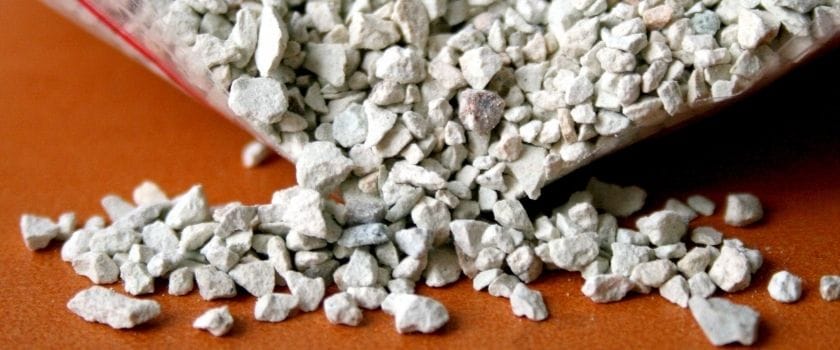
Zeolite and activated carbon are two of the most widely used filtration media in water treatment. Both are porous and both have a large internal surface area, so they are often compared. In practice they do different jobs: zeolite works mainly as a mechanical filter and an ion exchanger, while activated carbon works by adsorption. Choosing between them, or combining them, depends on what needs to be removed from the water.
What zeolite is
The zeolite used in water filtration is usually clinoptilolite, a natural aluminosilicate mineral of volcanic origin. Its crystalline structure contains channels and cavities that give it a large surface area and an ability to exchange cations.
In a filter bed, zeolite is used in two ways:
- As a filtration medium, in place of or alongside silica sand. Its irregular, porous grains retain suspended solids and turbidity, and its lower density means it needs a lower backwash rate than sand.
- As an ion exchanger, mainly to remove ammonium. It can also retain some metals, such as lead, depending on the water chemistry.
What activated carbon is
Activated carbon is made from carbon-rich raw materials, such as coal or coconut shell, which are activated thermally or chemically to create a highly porous structure. Its surface attracts and holds dissolved molecules by adsorption.
In water treatment it is mainly used to remove:
- free chlorine and chloramines;
- compounds that cause unpleasant taste, odour and colour;
- dissolved organic matter;
- pesticides, solvents and other organic micropollutants.
Once its adsorption capacity is exhausted, the carbon has to be replaced or regenerated.
Main differences
| Zeolite | Activated carbon | |
|---|---|---|
| Origin | Natural mineral (aluminosilicate) | Manufactured from coal, coconut shell or wood |
| Main mechanism | Mechanical filtration and ion exchange | Adsorption |
| Removes well | Suspended solids, turbidity, ammonium | Chlorine, taste and odour, organic matter, organic micropollutants |
| Removes poorly | Chlorine, dissolved organic compounds | Ammonium, dissolved salts |
| Regeneration | Backwashing; ion exchange capacity can be restored with brine | Replacement or thermal reactivation once exhausted |
| Typical use | Pressure filters, multimedia beds, aquaculture, ammonium removal | Dechlorination, drinking water polishing, pretreatment before reverse osmosis |
When to use each one
Zeolite is a good choice when the priority is to reduce turbidity and suspended solids, or when the water contains ammonium, as in some groundwater, aquaculture water and treated effluent.
Activated carbon is the right choice when the water contains chlorine, taste and odour compounds or dissolved organic contaminants. It is also used to protect reverse osmosis membranes from chlorine.
Both together are common. A typical arrangement is a zeolite or multimedia filter to remove solids, followed by an activated carbon filter to remove chlorine and organic compounds. Placing the carbon after the solids filter also extends its service life.
How to choose
The choice should start from a water analysis and the quality required at the outlet. Flow rate, bed depth, contact time and backwash conditions then determine the size of each filter.
KEIKEN supplies filtration media, including zeolite, activated carbon and anthracite, and designs pressure filters. Email info@keiken.es or contact us for technical advice.