
- Home
- Compact Plants
- Drinking water treatment

Compact DRINKING WATER TREATMENT plants.
We design and manufacture compact drinking water treatment plants from 20 to 2,500 m³/day, capable of treating water from boreholes, rivers and aquifers.
With fresh water in limited supply, we make use of these sources to transform them into high-quality drinking water, adapting to the characteristics of each source and ensuring a safe, reliable supply.
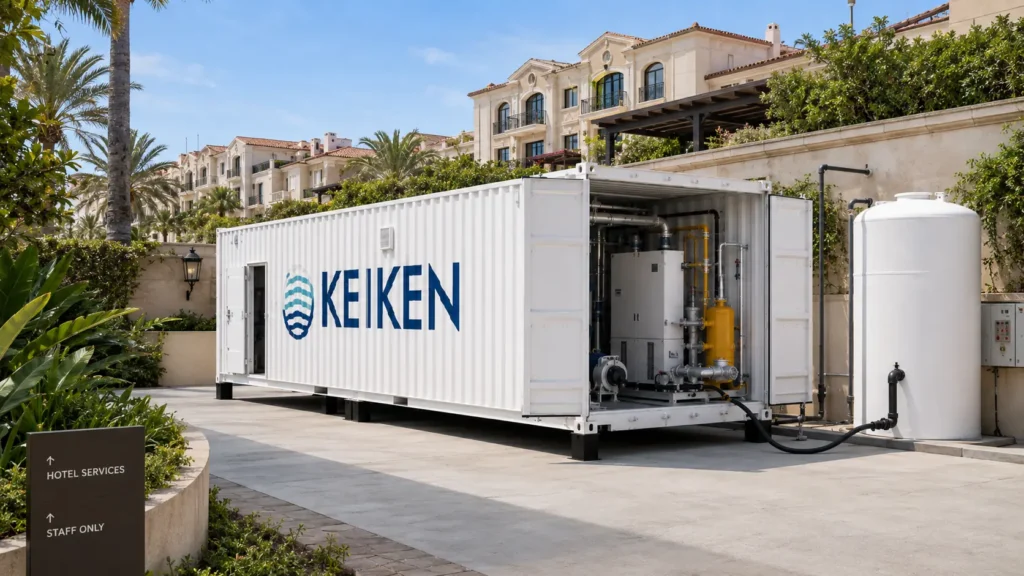
Skid-mounted or containerised (20 or 40 feet)
Arrive and connect
Recovery rate of 70% or above
Reduced O&M and remote monitoring
Low energy consumption
Drinking water treatment for borehole, river or aquifer water
Fresh water accounts for only 2% of the water available on the planet. As a result, boreholes, rivers and aquifers are strategic sources of supply, although their composition and flow rates can vary significantly.
At KEIKEN, we develop compact, containerised drinking water treatment plants capable of conditioning and treating this water to provide a supply that is high-quality and suitable for human consumption, even in remote locations or challenging conditions.
The installations incorporate advanced prefiltration, reverse osmosis and automatic membrane cleaning, together with control systems and climate control inside the container. Their design enables rapid commissioning and straightforward operation, with a recovery rate starting at 70% and optimised energy consumption through energy recovery devices.
Outlet water quality can be customised to suit the feed water characteristics and project requirements, providing a compact, efficient and reliable solution to ensure access to drinking water.
From water analysis to commissioning.
Design and engineering
We design and define the process according to feed water quality, the required flow rate and the final objective.
In-house manufacturing
We assemble and integrate equipment, piping, instrumentation and control at our facilities.
FAT testing
We test and validate the plant in our testing area before dispatch to reduce adjustments at its destination.
Commissioning
We install, start up and verify the plant’s operation at its destination.
Support and control
Technical support, monitoring of parameters, alarms and operation, with optional remote monitoring.
What are the benefits of a drinking water treatment plant?
Secure supply. Reduced reliance on the mains and security of supply.
Use of local resources. It enables water from boreholes, rivers and aquifers to be transformed into high-quality drinking water.
Efficiency and lower environmental impact. Low energy consumption, optimised water use and the option to incorporate solar PV for self-consumption.
High-quality water without the need for tanker deliveries. Treatment tailored to each source to ensure water quality.
Compact, mobile and Plug & Play. A containerised design with fast installation, easy transport and relocation to suit project needs.
Flexible and scalable. Solutions adaptable to different production and demand requirements, for permanent installations and temporary or emergency needs.
Experience demonstrated on site.
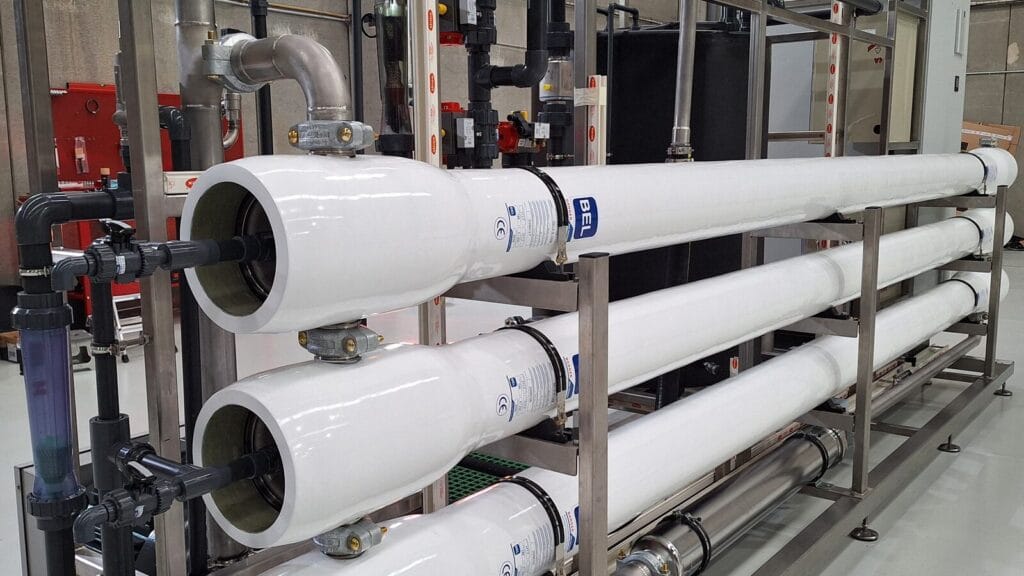
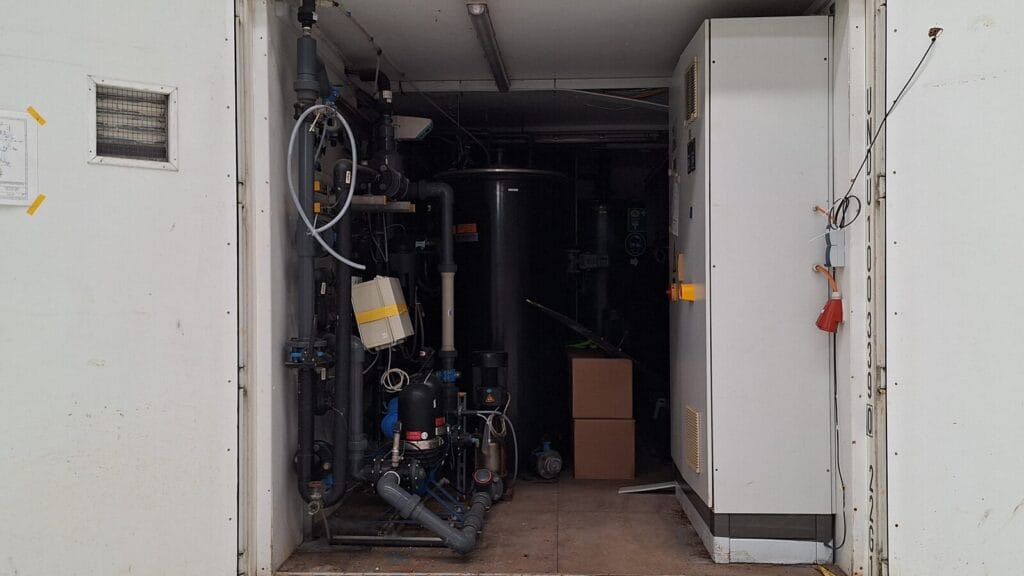
A selection of projects where we have provided engineering, equipment or installation in different settings.
Your questions about compact drinking water treatment, answered.
What types of water can a compact drinking water treatment plant treat?
Surface water, borehole water or mains water requiring additional treatment. Source characterisation determines the stages: turbidity, organic matter, iron and manganese, hardness, salinity and microbiological quality must be assessed according to the project.
How is the water verified as suitable for human consumption?
The treatment train is designed to meet the required quality and verified through checks and analyses. In Spain, the reference is Royal Decree 3/2023. Treatment, operation, storage and distribution conditions must be assessed together.
Can the plant adapt to seasonal water variations?
Yes, if the design accounts for the source’s range of quality and flow rates. This requires representative analyses and variation data. Automation can adjust dosing and backwashing within the limits defined for the installation.
What technologies can a compact drinking water treatment plant include?
Depending on the water, it may combine coagulation, flocculation, settling, filtration, adsorption, membranes and disinfection. If salinity requires reverse osmosis, we assess a brackish water or seawater desalination train integrated with the necessary post-treatment.
Can the drinking water treatment plant be installed in a container?
Yes. The treatment system can be skid-mounted or containerised. The layout depends on the flow rate, treatment stages and maintenance space, as well as site access and connections.
How is the disinfection system selected?
Water quality, flow rate, the microorganisms to be controlled, and storage and distribution conditions are considered. Selection of the system and its control forms part of the design of the complete treatment train.
What automation and instrumentation can the plant incorporate?
It may include a PLC, HMI screen, data logging, alarms, dosing control, analysers and sampling points. Variable selection and remote monitoring are tailored to operating requirements.
What maintenance does the plant require?
Equipment checks, filter backwashing, instrument calibration, replenishment of consumables and chemicals, and maintenance of the disinfection system. The programme is adapted to feed water quality and the supplied configuration.
Do you include training for operating staff?
Commissioning may include practical training and documentation for operation, maintenance and responding to alarms. The scope and duration are agreed with the person responsible for the installation.
What flow rates do compact drinking water treatment plants cover?
The range covers 20 to 2,500 m³/day. The usable flow rate depends on feed water quality, the selected treatment train and the treatment’s internal water consumption. Expansion is assessed using parallel modules.
What are the delivery and commissioning times?
The indicative delivery lead time is 8 to 14 weeks, subject to the configuration, availability and confirmed scope. Commissioning is a subsequent stage: it depends on the site, connections and utilities being ready and on completion of the planned tests.
What information do you need to prepare a quotation?
Representative water analyses, daily and hourly flow rates, required quality, location, space and available utilities. Seasonal variations and storage and distribution conditions should also be specified. Request a drinking water treatment proposal with this information.
Tell us your water source and the quality you need.
Every project starts with different conditions. Tell us the water source, required flow rate and required drinking water quality. With this information, our team can define the most suitable treatment, capacity and configuration for your installation.
You do not need to have the solution defined. We begin by analysing your needs.
We are a B Corp company
B Corp certification independently assesses a company’s environmental and social performance, transparency and legal accountability. For us, it is more than a label: it provides a framework for our technical decisions. Every plant we design is also assessed for its energy consumption, the water footprint it helps reduce and its impact where it is installed.